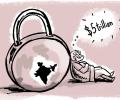
Chief Economic Advisor V Anantha Nageswaran on Thursday expressed hope that the economy will maintain the trend growth rate of 6.5 per cent and above for the rest of the years in the current decade. The economy will close the current fiscal logging in a growth of 6.5-7 per cent, he said, citing the projections of private sector analysts, Reserve Bank of India (RBI) and international agencies like OECD and the IMF. "This appears to be reasonable at this point in time although we will get the data on the fiscal second quarter in a few days, which will give more clarity on these numbers.

'Continue with your SIPs to get the benefit of lower average prices in this challenging market environment.'

The rating agency said, rising COVID-19 cases in India will keep private spending and investment lower for longer.

The advantage of leasing is that you can get a new car every few years. You can also get to drive a high-end car without paying its entire price.

'Rahul needs to play county cricket, but will he skip the IPL?'

'The market will focus on the fact that India does have strong earnings growth this year.'

Stocks of public sector companies, especially the oil refining and marketing companies (OMCs) - Bharat Petroleum Corporation Limited (BPCL), Hindustan Petroleum Corporation Limited (HPCL) and Indian Oil Corporation Limited (IOC) - logged gains on Tuesday in a weak market. While the Nifty lost nearly 1 per cent in trade on Tuesday, the Nifty CPSE index - a gauge of performance of central public sector enterprises on the National Stock Exchange (NSE) - gained over 3 per cent in intra-day trade. The rally in PSU stocks comes on the back of the BPCL chairman, Arun Kumar Singh suggesting in the company's annual general meeting (AGM) on Monday that the government intends to complete the divestment process in the OMC by March 2022.

Difficulties in containing the virus, an anaemic policy response, and underlying vulnerabilities, especially across the financial sector, are leading us to expect growth to fall by 5 per cent this fiscal year before rebounding in 2021, S&P said in a report.

Asset-weighted returns of large cap funds lagged their benchmark by 273 basis points, ELSS funds by 318 bps and mid- and small-cap funds by 230 bps.

Nikunj Saraf, Vice President Choice Wealth, answers your queries.

Flush with liquidity, banks are eager to lend. And, therein lies the problem, warns Tamal Bandyopadhyay.

S&P Global Ratings on Monday retained its forecast of 9 per cent contraction in the Indian economy for the current fiscal, saying even though there are now upside risks to growth but it will wait for more signs that COVID infections have stabilised or fallen. S&P, in its report on Asia Pacific, projected the Indian economy to grow at 10 per cent in the next fiscal.

The Indian economy recovered from the Covid-induced downturn during 2022 and is poised for further improvement in the coming quarters though downside risks emanating from geopolitical tensions, strengthening dollar and elevated inflation will continue. The positive trajectory in the growth trend and improved fundamentals will help the nation in neutralising the impact of global headwinds which are expected to have a bearing on the country's exports in the months to come. The challenges before the government and the Reserve Bank in the new year would be to arrest inflation, check declining value of rupee against US dollar and promote private investment and growth, with a view to ensure that the country remains one the fastest growing major economies of the world.

Shares of Indian Railway Catering and Tourism Corporation (IRCTC) hit a new high of Rs 4,512 after surging 8 per cent on the BSE in Wednesday's intra-day trade, on the back of heavy volumes, ahead of 1:5 stock split. The trading volumes on the counter more-than-doubled today, with a combined 7.02 million equity shares having changed hands on the NSE and BSE till 11:19 am. In the past one week, the stock of the state-owned travel support services company has rallied 20 per cent after the company on September 29, 2021, said that it has fixed October 29, 2021 as the record date, to ascertain the name of shareholders entitled for subdivision/split of equity shares of Rs 10 each into five (5) equity shares of face value of Rs 2 each.

S&P Global Ratings has forecast India's economy to shrink by 5 per cent in the current fiscal. It, however, has projected GDP growth to be 8.5 per cent in 2021-22 and 6.5 per cent in 2022-23.

The Adani group will have understood the fragility of investor trust in the group. The group needs to improve transparency including in areas like share-ownership (which they have long and mistakenly believed can be side-stepped) and related-party transactions, among others, Amit Tandon and Hetal Dalal point out.

Tightening Russian gas supplies to Europe has led to scramble for tankers before winter sets in.

There has been a stellar rise for the Indian markets this far in calendar year 2021 (CY21) with the S&P BSE Sensex surging over 19 per cent. The gain in mid-and small-cap indices on the BSE has been sharper with both these indexes surging around 38 per cent and 54 per cent, respectively during this period. Rampant spread of Covid pandemic's Delta variant and the ensuing lockdown and mobility curbs across India, rising prices key commodities, including crude oil and its impact on inflation, possibility of tightening of policy stance by major global central banks, especially the US Federal Reserve (US Fed) have been some of the key headwinds that the markets successfully negotiated during this period.

Shares of Adani Green Energy (AGEL) continued their upward movement, hitting a new high of Rs 1,955.90, up 2.6 per cent on the BSE in Wednesday's intra-day trade in an otherwise weak market. The S&P BSE Sensex was down 0.77 per cent at 60,285 at 11:01 am. In the past 14 trading sessions, the stock of the renewable energy arm of the diversified Adani Group has zoomed 50 per cent from Rs 1,307.05 on December 30, 2021. In comparison, the S&P BSE Sensex was up 4.3 per cent during the same period.

Two firms belonging to the Adani group - India's most valued conglomerate - are part of the Nifty 50 index. The group, however, has no representation in the Sensex. And it could stay this way if a proposed index qualification rule change gets approved. Recently, Asia Index, a joint venture between S&P Dow Jones Indices and BSE responsible for index composition, floated a consultation paper where it proposed that a stock must have a derivative contract to be eligible for inclusion in the flagship 30-share Sensex index.

Conventional wisdom is that when the US sneezes, emerging markets like India catch a cold. And yet the Indian stock market went up last year, points out Debashish Basu.

An escalation in the already simmering tensions between North and South Korea, China and Taiwan, and Russia and Ukraine could prove to be a bigger worry for the markets over the next few months rather than central bank policy action, said analysts. The markets, they said, are still not fully factoring in this possibility. "The conflict between Iran and Saudi Arabia is another geopolitical worry.

The one-year returns for equity-oriented mutual fund (MFs) schemes have largely mirrored the gains made in the secondary market. However, schemes that invest in infrastructure (infra), small-cap, and public sector undertaking (PSU) banks have emerged standout performers, with gains in excess of 100 per cent in some cases. Of the total 484 equity schemes, 353 have managed to beat the Sensex, reveals the data provided by Value Research. Around 20 have delivered returns in excess of 90 per cent and six schemes have given returns of over 100 per cent in the past one year. The S&P BSE Sensex Total Return Index (TRI) has given returns of 51 per cent in the last one year, ended October 29.

The lifters will work with Dr Aaron Horschig, a former weightlifter-turned-physical therapist and strength and conditioning coach.

Some of India's largest companies have seen a slowdown in the growth of temporary, contract and casual jobs, as compared to the increase in their total workforce. The absolute number of such jobs is up 30 per cent between financial year 2017-18 and 2021-22 (FY18-22), shows an analysis of data collated from the annual reports of S&P BSE 100 companies. Forty-eight firms were considered for the final analysis based on the availability of uniform data across the last five years. In comparison, the total workforce numbers are up 36 per cent in the same period.

Buying a car, particularly a diesel-powered one, is set to pinch the customers' pockets even more from the next financial year, as the second phase of Bharat Stage VI (BSVI) emission norms kicks in. The rules require cars to be compliant with real driving emission (RDE) norms, which measure pollutants emitted by cars while they are being driven on the road, unlike in a laboratory test. The norms may increase the cost of producing diesel vehicles by nearly Rs 75,000 to Rs 80,000, and petrol-powered ones by Rs 25,000 to Rs 30,000, analysts said.

Shantanu and Nikhil's collection Declaration 2034, heavily inspired from military uniforms, highlights gender neutral fashion.

Omkeshwar Singh, Head, Rank MF, a mutual fund investment platform, answers your queries.

Clock 11% growth in the first 11 months of 2022.

Foreign portfolio investors (FPIs) turned net buyers in October after being net sellers in the previous month. In October, FPIs bought shares worth nearly Rs 8,430 crore ($1 billion) against net selling of Rs 13,405 crore ($1.6 billion) in September. Positive flows during three of the previous four months have pushed the domestic markets towards fresh all-time highs. At present, the Sensex and Nifty are less than 2 per cent shy of breaching record highs logged in October 2021. A rally in equity markets in the US and Europe is in hopes that the Federal Reserve may go soft on rate hikes after its November meeting.

That means a manufacturer looking at a market like India needs to decide whether small, cheap cars or small, expensive cars or both will work better for them, says Pavan Lall.

Experts say, investors will be better off exiting them at higher levels and investing in stocks of fundamentally sound companies.

Analysts suggest investors remain in a wait-and-watch mode and not jump in to buy stocks across-the-board.

as the FAME II deadline of March 31, 2024, nears, EV manufacturers are worried about their investments and future plans.

SBI's ownership should give confidence to depositors and lenders about the bank's solvency.

It has mostly been a one-way street for markets that have moved up sharply since July. The front-line indices - the S&P BSE Sensex and the Nifty50 - have gained 6.7 per cent and 7.3 per cent, respectively, in the past three months. The rally in mid- and small-caps has been sharper, with both indices surging 14 per cent and 9 per cent, respectively, during this period. This sharp run has made analysts at Jefferies cautious.

Earlier in May, Ford India announced that it had dropped its plans to make electric vehicles (EVs) in India, which it intended to export, under the production-linked incentive scheme (PLI). Ford was among 20 companies that had signed a Champion OEM Incentive Scheme under the PLI project with the government in February this year. The decision comes as a blow for the 4,000-odd employees at Ford India's Maraimalai Nagar plant near Chennai and in Sanand, Gujarat. In September last year, the company had announced that it would exit the India market, which it had entered in 1995 through an on-again, off-again joint venture with Mahindra & Mahindra (they split in 1998, signed a JV in 2019 and split again in December 2020), retailing petrol and diesel brands such as the EcoSport, Figo, Aspire, and Endeavour.

S&P Global Ratings on Wednesday lowered India's economic growth forecast to 5.2 per cent for 2020, saying the global economy is entering a recession amid the coronavirus pandemic. The agency had earlier projected a growth rate of 5.7 per cent during the 2020 calendar.

The latest circular from BSE that sought to cap the price movement of select scrips, especially the mid-, small-cap segments, traded on the exchange is not without a reason. A quick calendar year-to-date price check on the stocks from the categories put under 'Add-on Price Band Framework' by the BSE reveals a total of 210 stocks have seen their market price more than double. Among individual stocks, SC Agrotech, Adinath Textiles, Waaree Renewable Technologies, Steel Strips Infrastructure, Unistar Multimedia, Texel Industries, Raja Bahadur International and Hindustan Everest Tools from the BSE's X and XT group have rallied over 500 per cent during this period. Topping the charts is Gita Renewable Energy, which has zoomed 3,964 per cent to Rs 272.35 now from Rs 6.7 as on December 31, 2020.

The most important positive of India's stealth bull market is earnings growth across different sectors, explains Debashis Basu.
